
How to Check Criminal History in Stonewall
Begin with the kind of record, not merely the town name. A sheriff report, parish booking, mayor's-court citation, and district-court disposition are separate documents. Stonewall's shared Government Plaza makes in-person access convenient, but co-location does not make one office custodian of another's files.
- Ask which agency handled the event. Start with DPSO for current parish or contracted law-enforcement activity, and with LSP for a state-police incident.
- Request the originating report using the report number or the date, time, location, and specific record component.
- Contact Stonewall Mayor's Court for a municipal ordinance citation, providing the citation number, defendant name, issuing agency, and date.
- Use DPSO for custody and the DeSoto Parish Clerk's Stonewall or Mansfield counter for a 42nd JDC prosecution.
- Use LSP/LBCII self-review for the subject's own fingerprint-supported statewide history.
Confirm identity with more than a name. Similar names, aliases, reporting delay, and the difference between an allegation and a disposition can otherwise produce a misleading result.
Stonewall Has No Current City Police Records Desk
State legislation allowed Stonewall's police department to be abolished and law-enforcement service to be contracted. That makes DPSO the practical current starting point for many Stonewall police and arrest records. Copying a generic city-page instruction to “contact Stonewall PD” would direct a requester to an office that does not exist.
The key question is who created the document. DPSO retains its incident, dispatch, arrest, and agency-media records. LSP retains a report for an incident its trooper handled. The jail maintains booking and custody information, while the Clerk owns the district-court file. A request should name the event and the likely agency, then ask for referral if the recipient is not the custodian.
Agency-wide DPSO crime totals cannot be presented as Stonewall city totals. The sheriff serves a larger parish area, and official crime statistics must be tied to a reporting agency, named year, and verified coverage months before making a city comparison.
Three Counters at Government Plaza
The official Stonewall contact page places Town Hall inside DeSoto Parish Sheriff's Government Plaza at 1746 U.S. Highway 171, P.O. Box 92, Stonewall, LA 71078. Town Hall is open weekdays from 7:30 a.m. to 3:30 p.m.; its office number is 318-925-9338 and fax is 318-925-9339.
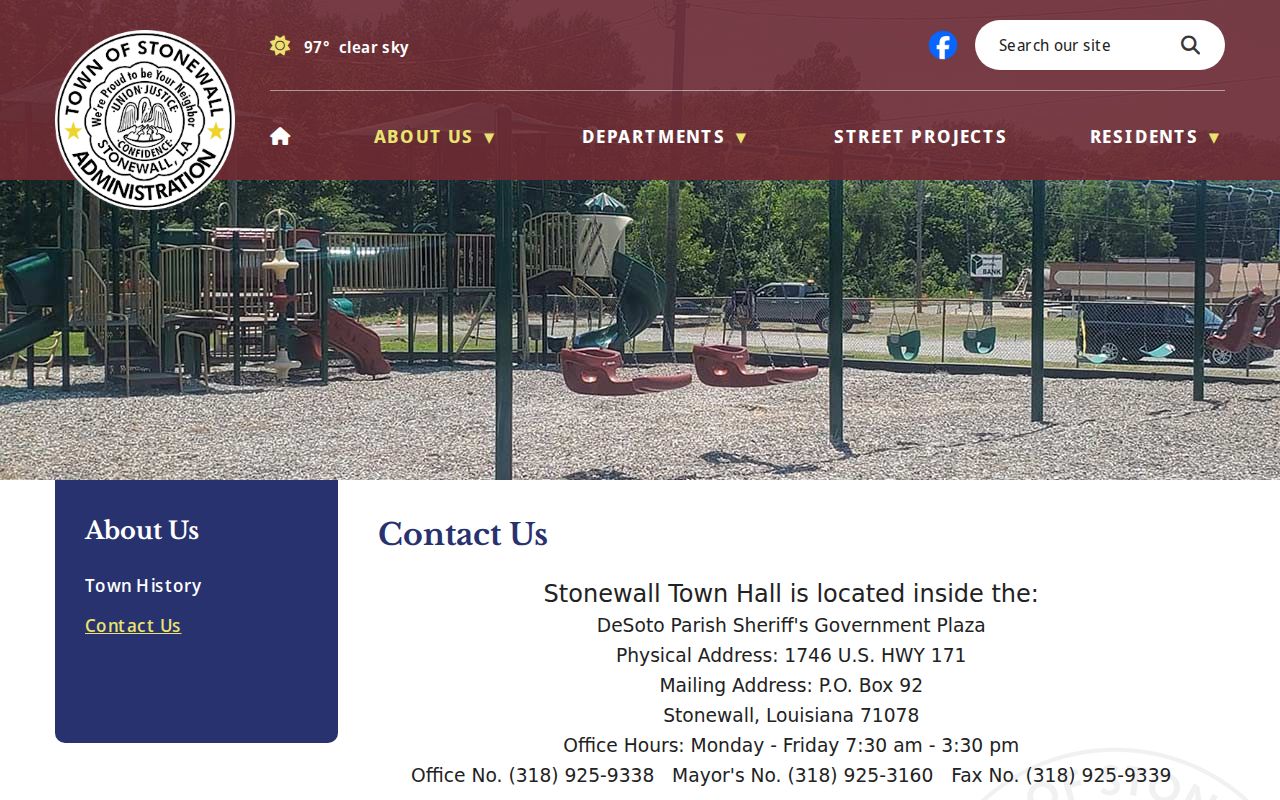
The image confirms the local counter details, but a visitor still needs to distinguish the town, Sheriff, and Clerk functions.
The DeSoto Parish Clerk also has a Stonewall office in the complex at 1746 Highway 171, Suite B, telephone 318-925-6655 or 318-925-6658. Its weekday hours are 8:30 a.m. to 3:30 p.m. Town Hall therefore opens an hour earlier. Mayor's Court uses the plaza as well. Shared geography along U.S. 171, near I-49 and a growing northern-parish community, is convenient, but records and payments remain institutionally separate.
Arrests and Bookings in Stonewall
A custodial Stonewall arrest delivered to the DeSoto Parish jail creates a DPSO booking record. The booking may show intake time, arresting agency, initial charges, bond, holds, custody status, and release information if published. It does not decide guilt. The district attorney may decline, amend, dismiss, or replace those allegations.
Use the official DPSO site and sheriff app for current arrest or inmate modules, then use a records request or official contact when the interface does not answer the question. Ask separately for a booking sheet, probable-cause material, incident report, dispatch record, or releasable image. If LSP made the arrest, its narrative remains with LSP even though DPSO may hold custody data.
A citation can produce a court record without a booking. Conversely, an incident report can exist without arrest or prosecution. The 42nd JDC file, available through ClerkNet or a Clerk counter, is where a parish charge and final disposition can be verified.
Stonewall Municipal Court Records
Stonewall's published 2025-26 notice schedules Mayor's Court at Government Plaza on the second Tuesday of each month at 9:00 a.m. Recheck the schedule before attending. Louisiana R.S. 33:441 authorizes mayor's courts over municipal ordinance violations. No official online Stonewall docket was located, so telephone or counter contact is the appropriate lookup channel.
| Court Name | Stonewall Mayor's Court at Government Plaza |
|---|---|
| Case Types Heard | Municipal ordinance and qualifying local citation matters |
| Case Lookup Channel | Town Hall telephone or counter; no verified public online case search |
| What the Docket Shows | Citation, charge or ordinance, setting, court minutes, and disposition |
| Copies & Fees | Confirm inspection, certification, delivery, and current cost with the town clerk |
Give the defendant or citation name, citation number, issuing agency, offense date, and the disposition or certified copy sought. Parish felony and misdemeanor prosecutions remain in the 42nd JDC, commonly centered in Mansfield.
Mayor's Court or 42nd JDC?
The issuing document usually supplies the first clue. A municipal ordinance citation belongs with Stonewall's mayor's-court channel. A parish charge, bill of information, arraignment, or district-court case belongs with the DeSoto Parish Clerk. A booking alone does not establish which charge was ultimately filed.
The Stonewall Clerk office can provide a local counter for parish files, but older or off-site material may require the main office at 101 Texas Street or Archives Building at 214 Washington Avenue in Mansfield. Search ClerkNet first, then call with the case number, defendant name, approximate year, and certification need. An online miss is not proof of no case.
Clerk criminal-copy information says ordinary documents other than minutes cost $1 per page, certification adds $5 per document, court-minute extracts are $10 per date, and certification adds $5. Reconfirm before ordering. The Clerk also states it does not accept credit or debit cards for criminal copies and does not collect criminal-sentence fines or traffic payments.
Where Stonewall Records End Up
A present-day Stonewall incident often starts in DPSO records rather than a municipal police office. A custodial event adds a parish booking. A municipal citation remains with Mayor's Court, while a parish prosecution moves through the district attorney and 42nd JDC Clerk. Fingerprint-supported data and dispositions may later reach LBCII's Louisiana Computerized Criminal History.
Record flow: DPSO or LSP in Stonewall › Stonewall Mayor's Court or DeSoto Parish 42nd JDC › Louisiana Department of Public Safety and Corrections, LBCII
For recent activity, check the originating agency and custody source. For a final parish result, use the Clerk. LACCH is an identity-based statewide layer, not a replacement for a local narrative, mayor's-court minute, or archived district file.
Louisiana Expungement Is Confidentiality, Not Destruction
Code of Criminal Procedure article 971 explains Louisiana's expungement purpose and effect.
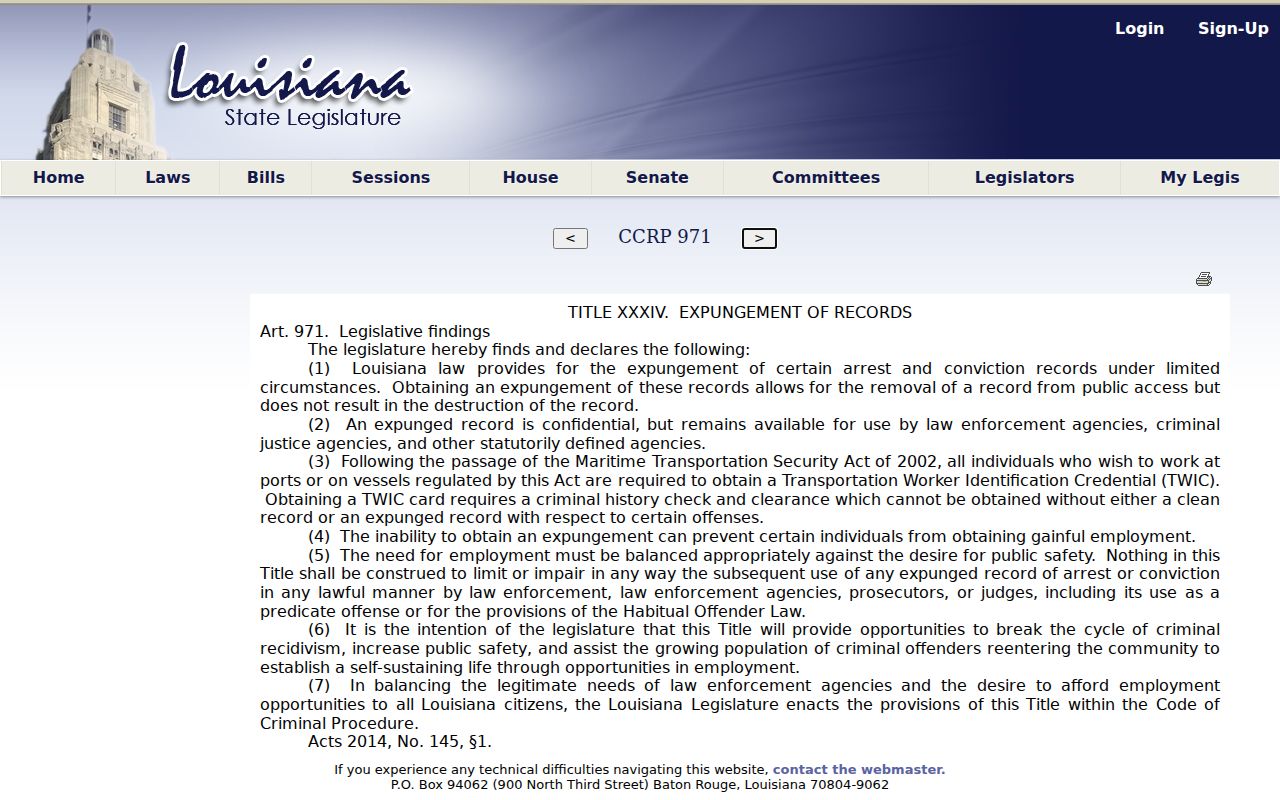
The statutory source shows why a qualifying order restricts public access without erasing every governmental record.
Article 972 defines the state's expungement vocabulary.
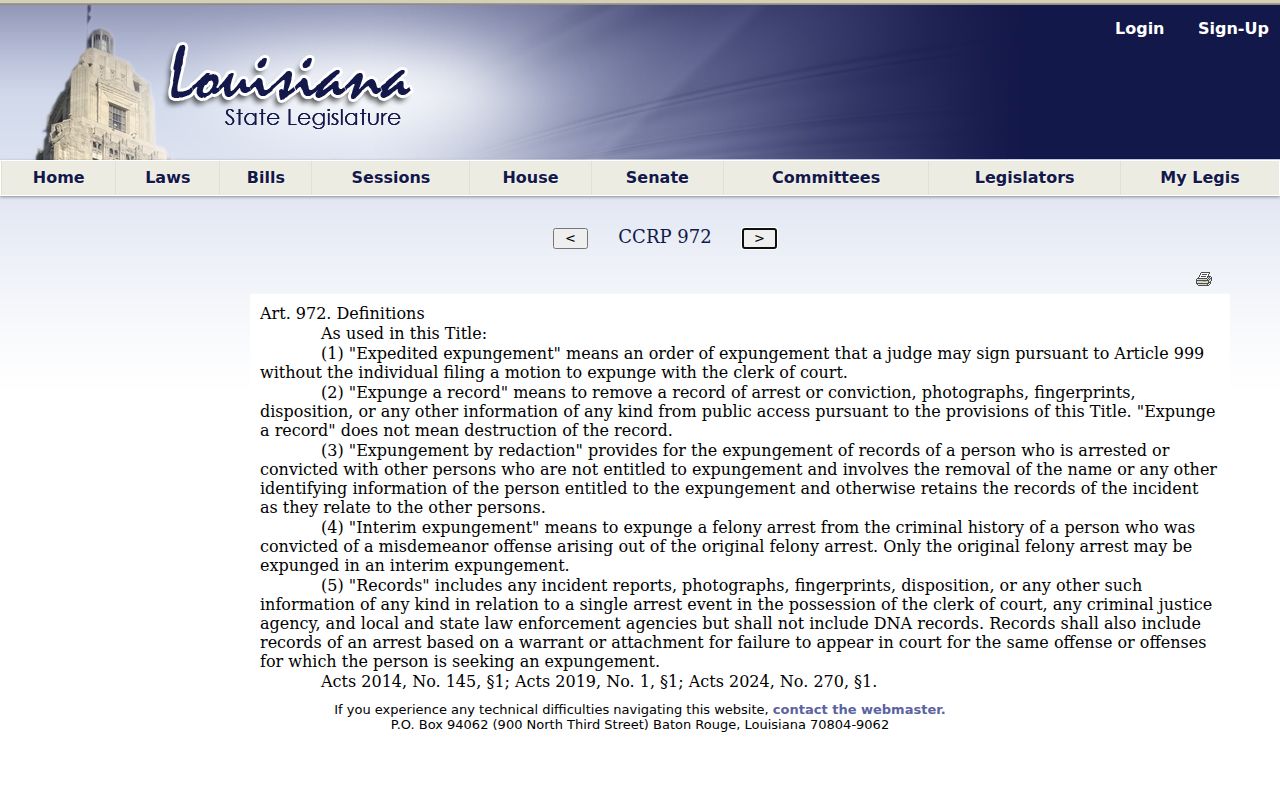
Those definitions help distinguish ordinary, interim, redaction, expedited, and other procedures rather than assuming one order fits every record.
Costs, Forms, and the Correct Stonewall Court
Article 983 addresses the expungement fee ceiling and allocations.
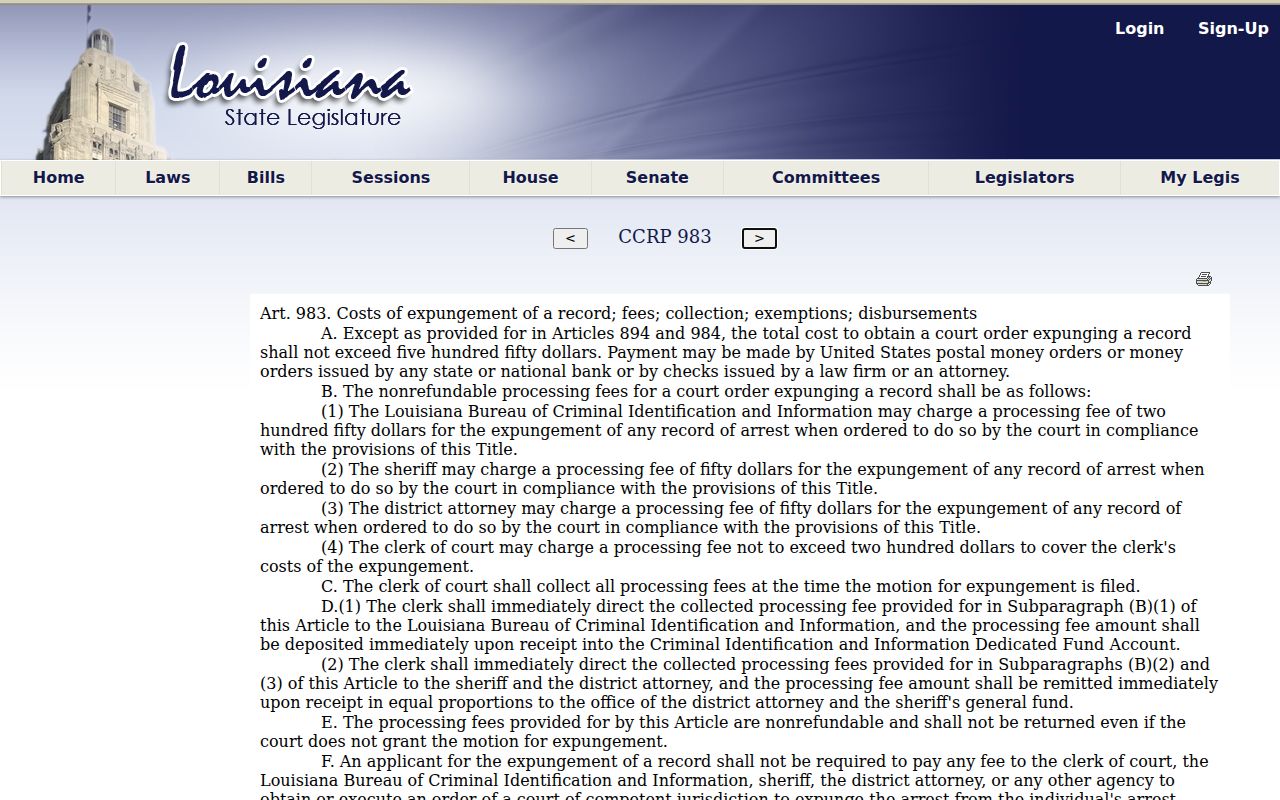
The statute, not an assumed local price, controls the ceiling and allocation framework; current applicability should be checked when filing.
Article 986 supplies mandatory expungement forms.
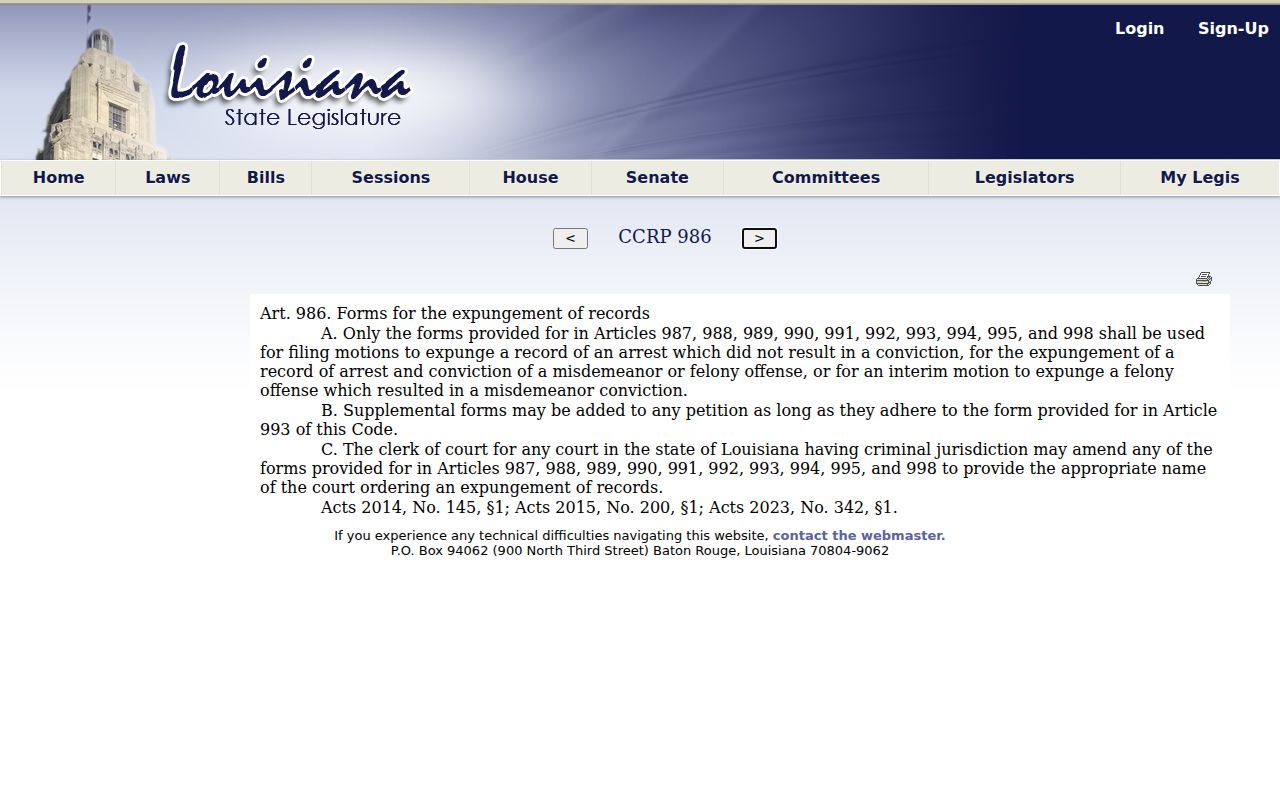
The form source reinforces a practical rule: first identify whether the record arose in Stonewall Mayor's Court or the 42nd JDC. Filing in or requesting a disposition from the wrong institution delays review.
After an order, keep certified copies and check each relevant layer. Public portals can update at different times, and LBCII correction may require a certified disposition.
What to Bring to a Stonewall Counter
For Mayor's Court, bring the citation or defendant name, citation number if available, issuing agency, offense date, named ordinance or charge, and a clear statement of whether a docket check, minutes, disposition, ordinary copy, or certification is needed. Confirm the court schedule rather than relying on an old notice.
For a DPSO record, identify the report or booking number, event date and time, location, arresting agency, and components sought. Request electronic delivery and an estimate before reproduction. If material is withheld, ask the custodian to release segregable nonexempt portions.
For the Clerk, provide the case number, defendant name, approximate year, document date, and certification requirement. Note the different Town Hall and Clerk opening times. Calling the correct office before traveling is especially useful because Government Plaza houses related but independent services.
Correcting a Stonewall Record
First identify which office owns the disputed field. DPSO addresses its report or booking data, the town court addresses its citation and minutes, the Clerk addresses the 42nd JDC file, and LBCII addresses the statewide fingerprint history. Keep each response with the request that produced it. A report number can connect a narrative to a booking, while a court case number connects filed charges to the final disposition.
If a name, charge, or date differs between systems, do not silently merge the records. Ask the responsible custodian what documentary proof its correction procedure requires. A certified disposition is especially useful when a statewide record lacks the local outcome. A dismissal changes the court result, but does not by itself make an accurate historical arrest false or remove it from public access.
Public Access Rules for Stonewall Records
Louisiana Public Records Law applies to local public bodies, but it does not make every police or court detail open. Active-investigation material, juvenile files, sealed cases, victim-sensitive information, medical details, confidential sources, and some audio or video may be withheld or redacted. A narrow request for identifiable existing records is more effective than broad questions.
Key Statutes:
Louisiana Public Records Law, R.S. 44:1 - Defines public records and covered public bodies.
Louisiana R.S. 44:3 - Establishes law-enforcement disclosure exceptions.
Louisiana R.S. 33:441 - Authorizes mayor's-court jurisdiction over ordinance violations.
Ask which office created the record, whether inspection or electronic delivery is available, what cost applies, and whether certification is necessary. That sequence respects Stonewall's unusual service structure and avoids inventing a municipal police custodian.